
They Didn't Know It Was Already the Final Act
"Every soul that walks through my curtain becomes a story. The question is… do they get a happy ending?"
4/6/202618 min read
"Every soul that walks through my curtain becomes a story. I decide if they get a happy ending."
The lanterns were still burning.
That was the thing about lanterns — they didn't know when a story was over. They simply went on casting their amber circles onto whatever the stage held, indifferent to the shift from performance to aftermath. From life to its opposite.
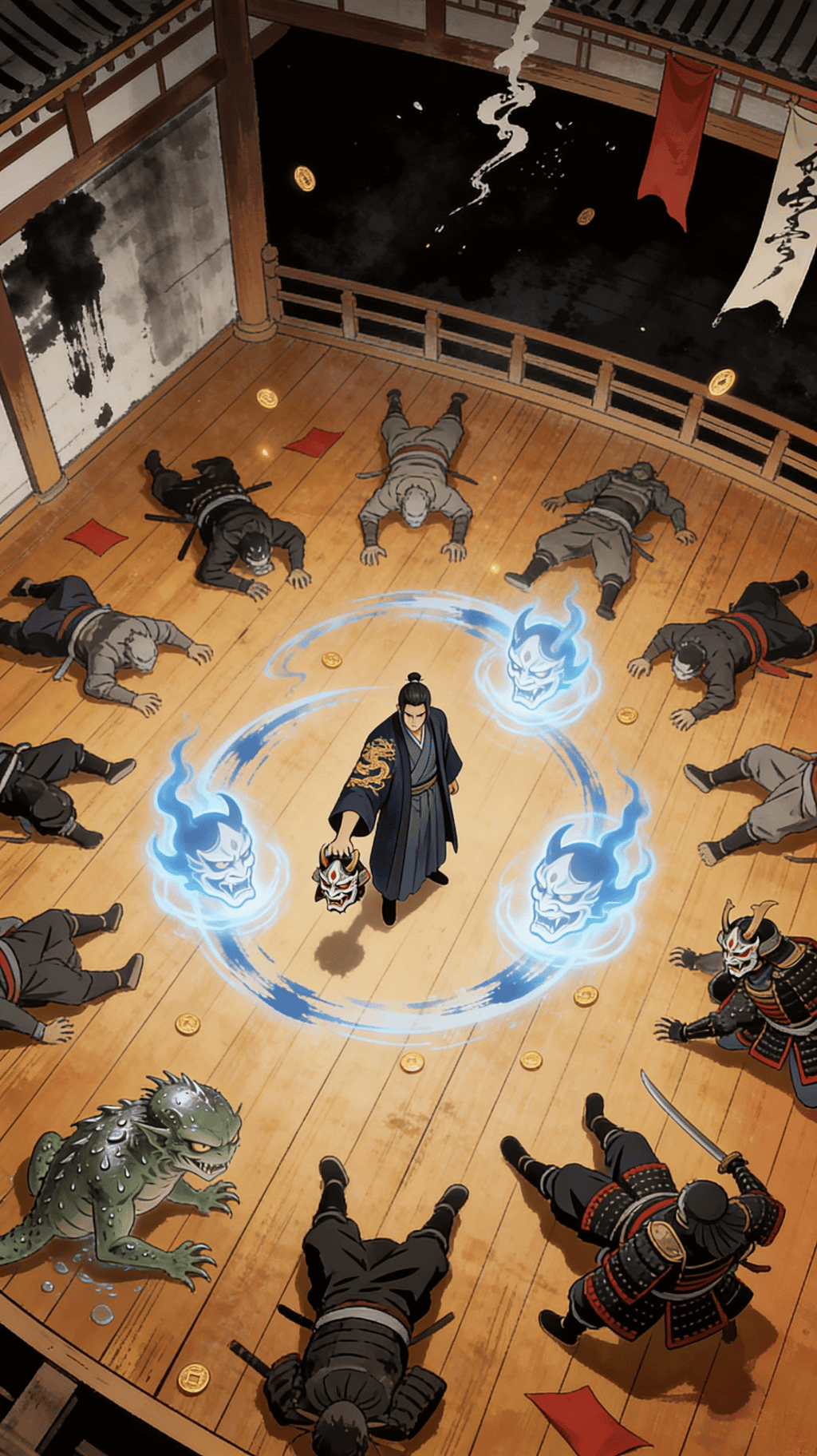
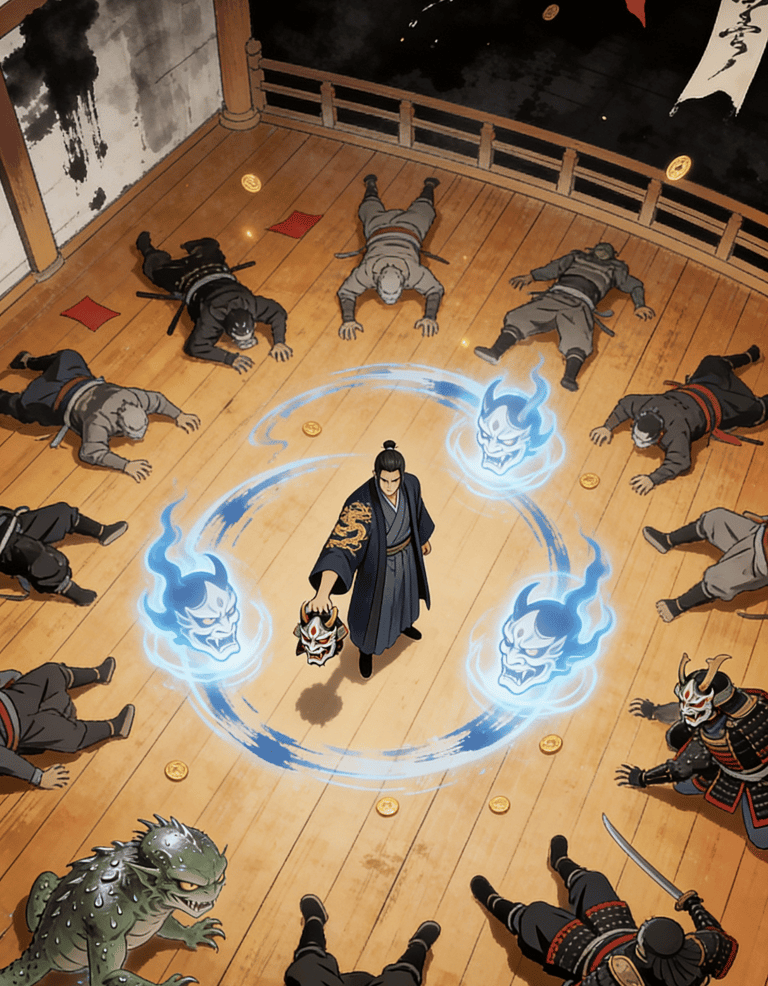
Twelve yokai lay across the boards of the Hana-za Theater. They had been many things when they walked in: soldiers, hunters, killers dispatched with a specific purpose. They were simpler things now. Props. The kind that get swept up before the morning rehearsal.
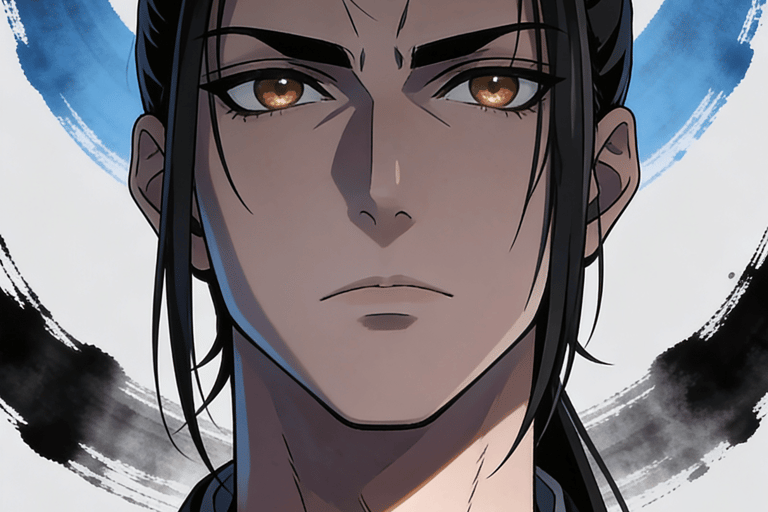
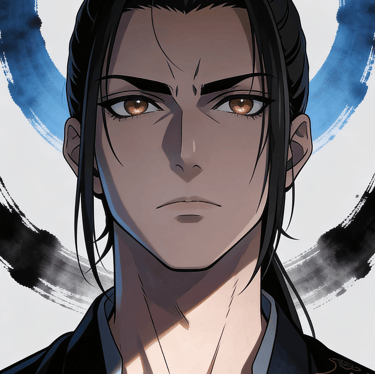
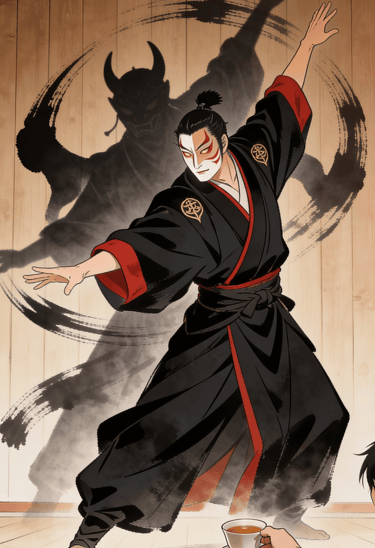
At the center of the destruction stood a single figure in dark navy robes with gold embroidery at the collar and cuffs. He held a carved Hannya mask at his side — its painted eyes dark now, the spirit fire in its sockets fully extinguished. Three ghost-shaped auras orbited him slowly, blue-white, fading. Coins scattered by the battle lay where they had fallen, some still spinning with a faint metallic sound in the silence.
12 Stories ended before they began.
The figure surveyed the stage the way a director surveys a set after the final performance: with the particular calm of someone for whom the outcome was never truly in question.
He turned to face the dark where the audience would have been, if there had still been an audience.
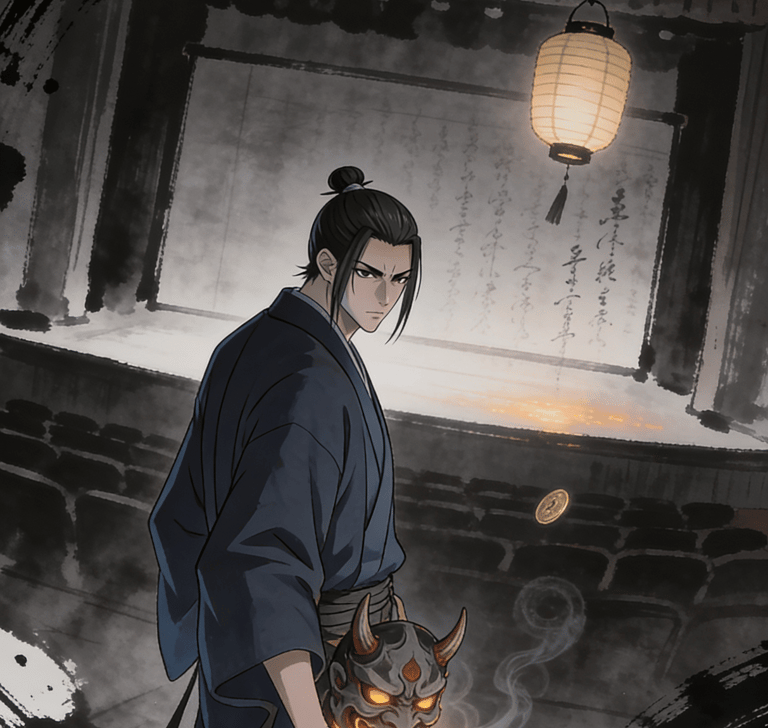
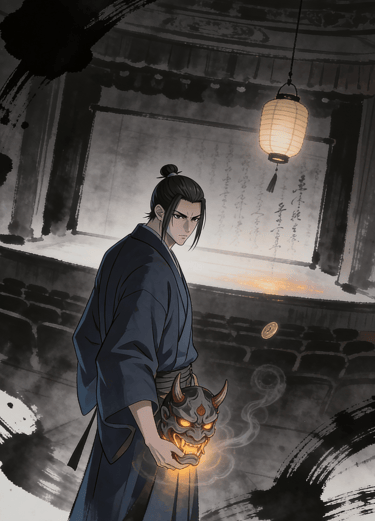
"My name is Ren and I will decided your role in this play." he said.
He paused. The lantern behind him swung once. Stilled. "Every soul that walks through my curtain becomes a story."
"The question is…" He set the mask against his leg. "Do they get a happy ending?". He looked at the Hannya mask in his hand. The painted demon face stared back at him, its carved eyes dark now, emptied of whatever fire had moved through them tonight.
He did not answer his own question. He rarely did. The question was for the audience. Everything he did was for the audience — even when there was no one left to watch.
One hour ago, he thought, the stage was full of people who were going to be fine.
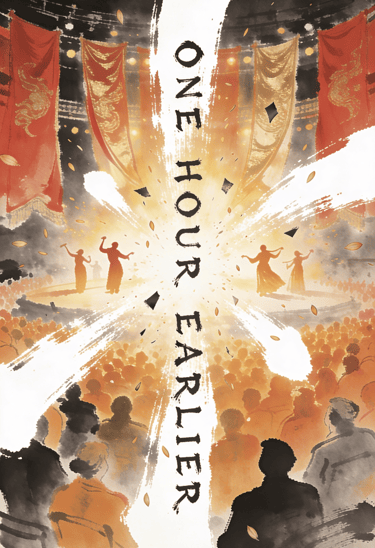
One hour earlier....
The world ran backward in his mind the way it always did when he gave himself permission to look — ink pooling back into the brush, fire returning to the wick, voices finding their words in reverse and swallowing them again. The demolished stage reconstructing itself board by board, curtain by curtain, person by person, until everything was whole again and the evening had not yet gone wrong.
He stood in the ruins for another moment, watching the past reassemble itself in his memory.
Then he let it go forward, as it had actually happened.
As it always happened, with him watching from the wings, three minutes ahead of everyone else, preparing the next scene.
He had appeared, as the story went, at a performance in Keimachi — walked onto the stage mid-scene, played the villain's role without a single missed cue, bowed to the stunned cast and crew, and then simply been there when the company left for the next city.
The Hana-za Traveling Theater Company moved the way water moves — following the path of least resistance, finding every low place in the terrain of commerce and filling it with performance. They had three wagons, eleven performers, two stagehands, one ancient cart horse named after a character from a play about a vengeful ghost, and a rotation of cities that kept them in enough coin to eat well six months out of eight.
Ren had been with them for longer than most could remember. Nobody had asked him to stay. He had not asked permission. He had simply become part of the company the way weather becomes part of a journey — present, accepted, essential.
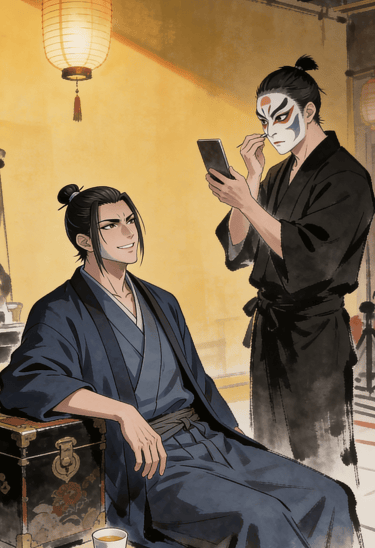
In the backstage of the Hana-za, on the night the story begins, Ren was laughing at something Ichiro had said about the props master's wig. It was a genuine laugh — the kind that didn't belong to any role, that had no audience, that served no purpose beyond the simple fact of a joke landing cleanly among people who knew each other well enough to be funny without trying.
He was, on that particular evening, exactly as happy as a person who has been hiding for most of their life can be. Which, he had found, was quite happy indeed, if you picked the right hiding place.
Aratake was applying his face paint with the focused attention of a surgeon and the expression of a man who has had this exact conversation a hundred times before and is prepared to have it a hundred times more.
The conversation, on this particular occasion, was being conducted entirely through looks. Ren set down a cup of tea beside the makeup tray. Aratake — without breaking the line he was drawing — picked it up, drank half of it in one movement, and set it back down. He had not looked at Ren. He did not need to. They had been doing this for ever and there was nothing left in either of their repertoires that required explanation.
He's never asked what I'm hiding from, Ren thought, watching him draw the red kumadori line with perfect pressure. He decided early on that it didn't matter. What matters is that we're moving.
He was right. It was, Ren had concluded, the most generous thing anyone had ever done for him.
The performance, by any objective measure, was going excellently.
The ghost play they had chosen for the Hana-za's opening night was one of the company's stronger pieces — a Noh-influenced story of a murdered lord whose spirit returned to name his killer, and Ren was playing the advisor who had tried to prevent the murder and failed. It was a good role. He liked roles where the character was smart but not smart enough. He found them easier to inhabit than pure villains, and more interesting than heroes.
He was mid-line when he saw it.
Not with his eyes — his eyes were exactly where the advisor's eyes should be, aimed at the actor playing the murdered lord with the appropriate expression of suppressed grief. With the other thing. The sense that arrived approximately three minutes before events did, like a letter from a future he couldn't refuse to read.
He saw the doors opening. He saw the crowd scatter. He saw twelve yokai enter a theater that had been, until that moment, a place where violence existed only in the script.
And he saw Ichiro step forward.
Don't, he thought, to the version of Ichiro who existed three minutes in the future and could not hear him. Don't step forward. I can't get to you in time.
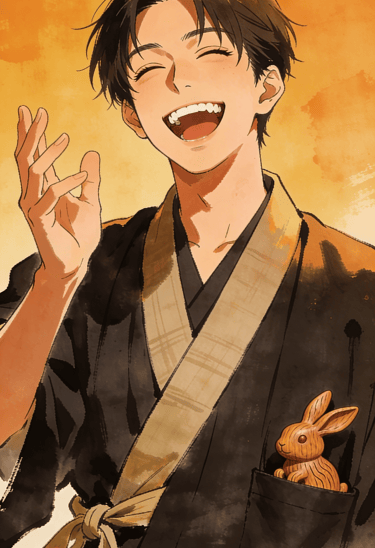
Ichiro had joined the company eight months ago in Naniwa
answering an advertisement for a prop runner and turning out to be, somewhat accidentally, a perfectly serviceable comedian. He had a face that did things without being asked — expressions arriving before decisions, every reaction visible at twice the normal speed. He laughed too loudly and ate too fast and had an absolute inability to pretend he wasn't having a good time when he was having a good time.
He carried, in his costume pocket, a small carved rabbit that he had been given by the props master as part of a minor role two months earlier and had simply never given back. The props master had not asked. The rabbit had become part of Ichiro in the way objects become part of people when both parties agree, without words, that it belongs there now.
Three minutes before the doors opened, he had caught Ren's eye across the backstage and given two enthusiastic thumbs up, still in costume, still riding the energy of a show that had gone better than expected. "Good crowd," he mouthed.
Ren had smiled. A real one — the kind that didn't belong to any role.
He kept that smile in his memory now, in the ruins of the Hana-za, standing over the place where Ichiro's carved rabbit lay alone on the stage boards in a small circle of amber lantern light. He kept it the way you keep something when you know you won't be getting any more of the thing it came from.
He had been right about the timing. He was always right about the timing.
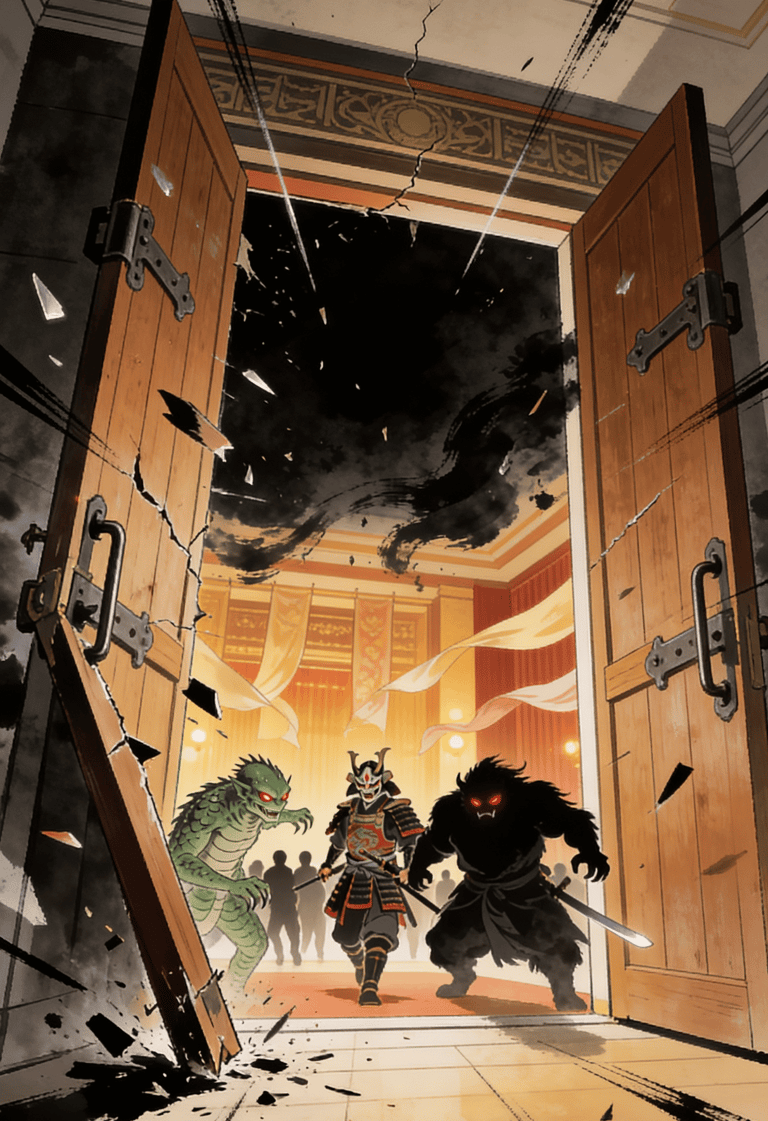
The doors hit at the exact moment his future-sight had indicated — both of them simultaneously, with enough force to break the upper hinge on the left door and drive the right one back into the wall hard enough that the impact traveled up through the building's frame and set the lanterns overhead swinging. The crowd reacted the way crowds react to sudden violence: all at once, in all directions, and loudly.
The company scattered. This was correct. This was what they had been informally trained to do, through years of performing in cities where violence was a weather event — unexpected but not unprecedented.
The twelve yokai came through the entrance in a controlled formation — not the chaotic rush of opportunistic attackers but the deliberate advance of creatures who had been sent somewhere specific and knew what they were looking for. Their eyes, red and fixed, moved across the stage with professional efficiency.
Ichiro did not scatter.
Ren, from the wings where the three-minute warning had put him, watched Ichiro step forward with the specific kind of courage that has not yet learned to calculate its own cost. The carved rabbit at their hip caught the light as they moved — a small warm gleam in the growing cold.
Don't, Ren thought again. I already know how this scene ends. You are not in my script for this part. Please—
The distance was eight steps. He had two seconds. He had neither.
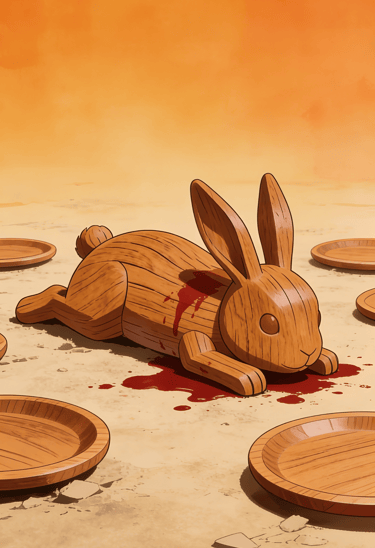
The small carved rabbit landed on the stage boards three feet from Ren's left foot and did not roll.
It simply landed and stayed there, as if it had decided this was where it lived now.
He looked at it for a long time.
He was aware of the yokai advancing. He was aware of Aratake, somewhere in the wings, making the specific quality of silence that meant I am here and I am waiting for your direction. He was aware that twelve armed creatures with a specific purpose were now between him and the theater exit, and that the remainder of this evening was going to be significantly more complicated than the first half.
He was aware of all of this in the same way you are aware of the weather outside a window you are not looking at. Present. Noted. Not the thing you are looking at.
He was looking at the rabbit.
"I saw that coming too," he said, to no one present. "I couldn't get there in time."
He had a skill that let him see three minutes into the future. He had watched Ichiro step forward and known, with the precision of someone reading a script, exactly how that scene would end. He had calculated the distance. He had calculated the time. He had found, as he occasionally found, that knowing was not the same as preventing.
"Three minutes is enough to prepare," he said. "It is not always enough to prevent."
He picked up the rabbit. He put it in his own pocket.
Then he turned to face the yokai, and reached for the Hannya mask.
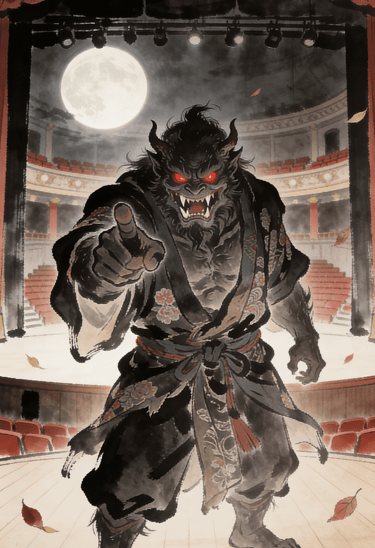
The yokai leader pointed at him. It was a direct, practiced gesture .
Ren looked at the pointing finger with the measured attention he gave to all things he was about to make use of.
"You stepped on my stage," he said.
"That makes you my cast," Ren said. "Whether you like it or not."
He reached into the prop chest beside him and took out the Hannya mask.
It was, in his hand, exactly as warm as it always was — as if it remembered every performance, every act, every face it had worn and everything those faces had done. The carved eyes were dark. Not for much longer.
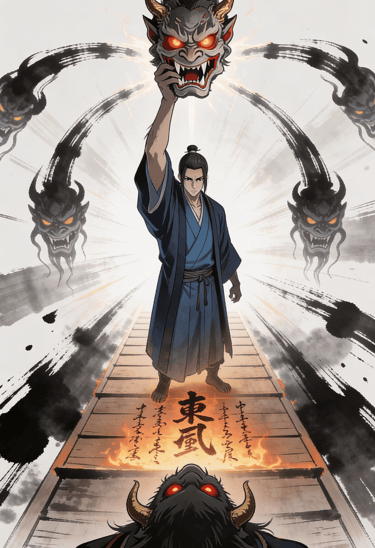
He raised it.
The Hannya mask, when it ignited, did not make the sound of a weapon being drawn.
It made the sound of a curtain rising.
The amber fire that bloomed from the carved eye sockets lit Ren's face from below in the theatrical tradition — footlights, the oldest form of dramatic lighting, the kind that turns a human face into something the audience cannot look away from. The three ghost-masks that launched from the mask's ignition point were, strictly speaking, impossible. They were also, strictly speaking, exactly what was happening — three spirit-shaped forms of light orbiting him in expanding circles, each one trailing a calligraphic arc of blue-white energy.
The yokai leader took a step backward.
He was not, Ren knew from experience, aware that he had done it. The future always arrived in the bodies first. The mind caught up later, when the event was already in progress and catching up was academic.
"Tonight's performance," Ren said, with the precise delivery of someone who has rehearsed this line ten thousand times and is choosing, on this particular occasion, to mean every word of it, "is Chūshingura. The 47 Ronin."
The calligraphic text burned itself into the stage boards around the yokai leader's feet, character by character, amber and gold.
"You're Lord Asano," Ren said. "I'm afraid it doesn't end well for you."
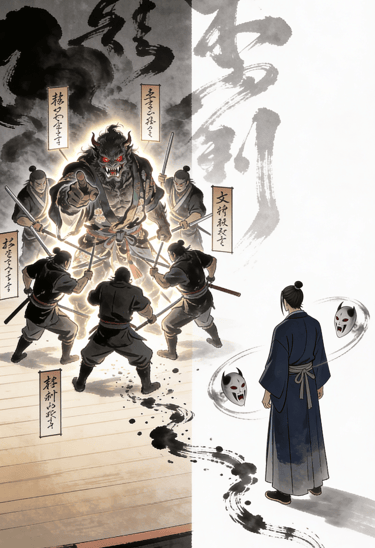
ACT 1: The Chūshingura effect was not subtle, but subtlety had never been the point of the 47 Ronin.
Subtlety was for plays that needed it. This one did not. This one was about the terrible pull of loyalty, the way it could override self-preservation, the way devoted men could cluster around a doomed lord and, in doing so, doom themselves along with him.
Ren watched eight of the twelve yokai begin pulling toward their leader as if gravity had been briefly redefined. Their feet moved. Their weapons lowered. Their eyes — which should have been tracking the threat — were drawn, with the inexorability of performance, toward the figure they had been assigned to protect.
Two of them collided. A third tripped over the second. The leader, now surrounded by allies pressing toward him from all sides, was shouting something that translated roughly to "get away from me and attack him" — instructions that his guards heard and understood and were, in this moment, constitutionally incapable of following.
Ren moved slowly and confidently through the gap their clustering had created.
The loyal retainers always protect the lord, he thought, even when protecting him is the thing that destroys them.
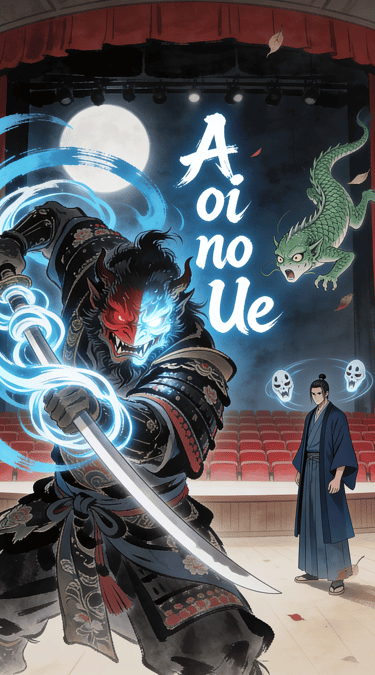
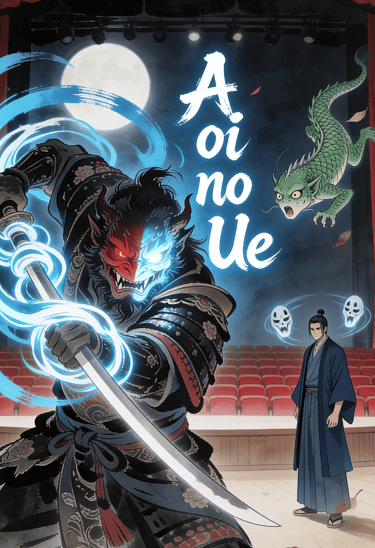
ACT 2: Aoi no Ue
The largest of the twelve was named, in the language of the clan that had sent them, something that translated approximately as "the one who breaks things."
The blue-white possession energy had arrived in its eyes the way understanding sometimes arrives — from the outside, washing in, replacing what had been there before with something that felt, from the inside, exactly like a decision, but was not. Lady Rokujō's jealousy, given theatrical form and purpose, was not cruel. It simply could not stop itself. It had loved too hard for too long and the love had become indistinguishable from destruction, and the creature it inhabited now experienced this from the inside as the puzzling sensation of wanting to do one thing while one's arm did something else entirely.
Its arm struck an ally. It looked at its arm. It struck another ally.
The yokai leader was screaming something. The possessed yokai registered the screaming the way one registers weather — present, noted, not actionable.
Ren moved through the space their scattered bodies had opened, passing close enough to the possessed one to see the confusion in its split eyes — red fury below, blue-white acceptance above. He did not look at it for long. He was already thinking about Act Three.
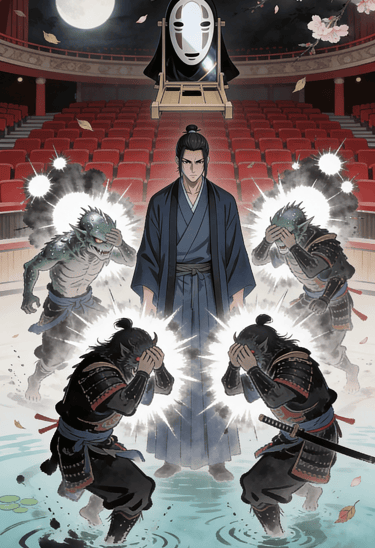
ACT 3: The Mousetrap was Ren's favorite of the three acts.
He would not have admitted this to anyone, but it was true. The 47 Ronin was elegant. Aoi no Ue was psychologically devastating. But the Mousetrap had, at its core, a philosophical satisfaction that the others lacked: the revelation that the crime and the punishment had always been the same thing, separated only by the time it took for the audience to understand the play.
The yokai leader charged with the specific fury of someone who had watched his formation collapse, his strongest fighter turn on its allies, and his carefully executed tactical advance transformed, somehow, into a theatrical catastrophe he could not explain. He came at the position where Ren was standing with everything he had.
There was nothing there. There was, instead, a blue-white ink-impression of where Ren had been three seconds earlier — an afterimage that looked, in the moment of the charge, exactly like a target.
The afterimage exploded in a burst of confusion light. The leader's own attack force — all the momentum and energy he had committed to the strike — had nowhere to go but back.
The Mousetrap reflected it double.
He hit the stage boards on one knee. He looked up, vision clearing, and found Ren standing two steps away, three ghost-masks orbiting, the Hannya mask raised. The leader had, Ren reflected, the specific expression of someone who has just understood that they have been in a play the entire time and has only now realized what role they were assigned.
"You confessed to the whole theater," Ren said. "There's nobody left to see it. But the principle holds."
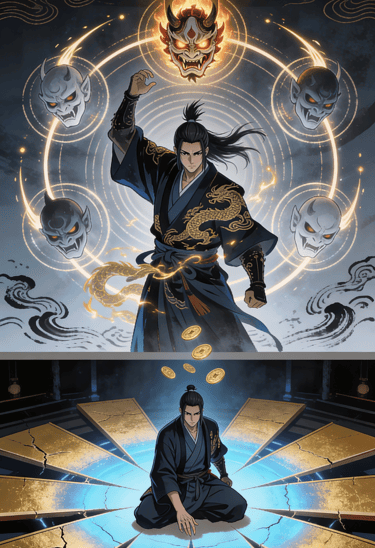
Three acts. Four conditions.
Two enemies carrying the mark of Ink on them from the confusion bursts. One ally in the wings — Aratake, still in the wings, which counted. The Shōri no Daishō required a cast. He was not going to end this scene alone.
The charge arrived in the stage boards first — they cracked outward from his feet in eight directions, the cracks glowing gold at their origin and cooling to blue at their ends, the boards fracturing along the lines of accumulated theatrical energy the way wood fractures along its grain. The amber around him built from the floor up, passing his knees, his waist, his chest, his face — until he was lit from the inside by something that had no technical name but which every performer in every tradition had felt at least once: the moment when the role and the self become indistinguishable, and everything you are goes into the next three minutes.
The four ghost-masks accelerated. The calligraphic wave-marks pulsed outward, concentric, synchronized with his heartbeat, or possibly the stage boards' cracking, or possibly both — he had stopped distinguishing.
"Final Acts of Death," he said, quietly, to the kneeling figure of the yokai leader below him.
He paused. He had always believed that the line before the final act deserved a pause. The audience needed a breath before the curtain fell.
"The curtain was always going to fall."
Another pause. Shorter. The energy pressing outward against the silence of it, impatient, enormous.
"I just wrote when."
And then: silence. One full second of it. The silence before the last line of the last scene of the last act of the play, which had always been going to end exactly like this.
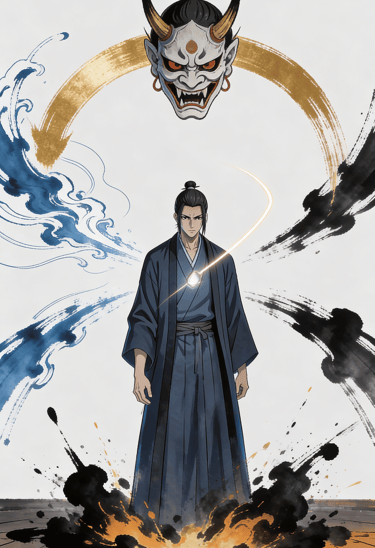
He lowered the Hannya mask one degree.
All four acts fired simultaneously.
He had staged many performances in his life. He had staged them in theaters and in city squares and in borrowed temple courtyards and in the middle of roads when the situation had required it. He had never staged one at this scale, with this many acts running simultaneously, in a space that had already been paid for with something that mattered.
The four waves of theatrical energy went outward in the visual languages of their traditions: the Chūshingura strike in the decisive gold of a sword wielded in honor's name; the Aoi no Ue tendrils in the elegant blue-white of a spirit that never wanted to cause harm; the Mousetrap's reflection in one clean geometric line, precise and merciless; the fourth act's ground energy upward from the boards in the dark amber of the theater's own accumulated history. They met at the positions of the remaining yokai with the specific inevitability of a curtain falling on a scene that has completed its purpose.
The yokai leader, frozen by the Stun effect in the position he had occupied when the final act began, looked like what he was: a character at the end of a play he had not understood he was performing until the final act.
The theater went quiet.
Ren lowered the Hannya mask to his side. The ghost-masks dissolved, one by one, their calligraphic trails fading back into the ink-wash atmosphere of the destroyed stage. The amber left his eyes. The stage boards' cracks stopped glowing.
The lanterns burned on, as lanterns do, indifferent to what the stage holds.
He was, once again, standing in the ruins of the Hana-za Theater, with twelve fallen yokai and one warm carved rabbit in his pocket, exactly as the episode had begun.
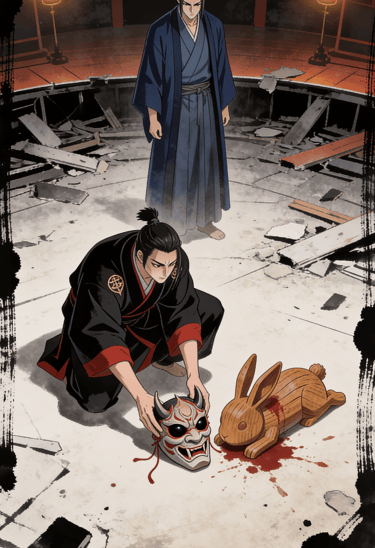
Aratake stepped out of the wings approximately thirty seconds after the last yokai fell.
He walked across the destroyed stage with the calm efficiency of someone whose job it was to keep moving regardless of what the stage looked like. He stepped over or around the fallen yokai without looking at them — not out of callousness, Ren knew, but because Aratake had decided, somewhere in the wings, that looking at them was not currently useful and would be done later, privately, at the correct time for it.
He stopped beside Ren.
They stood together for a while. The lanterns overhead swung gently in whatever draft moved through a theater after a battle. The carved rabbit sat in its small circle of amber light between them, patient and small and very much itself.
"We're going to need a new theater," Aratake said finally.
Ren crouched down. He placed the Hannya mask on the stage boards next to the rabbit. He did this carefully — the mask set down the way you set down something you are not ready to pick up again yet, but which needs to be put somewhere while you decide.
"We're going to need a lot of things," he said.
The mask lay dark on the boards. The rabbit lay beside it. Between the two objects was the precise measure of what the evening had cost, which was not a thing that could be expressed in any other way and so was expressed in this one: two objects, side by side, in a small warm circle of light.
Aratake did not ask him anything. He had always been very good at not asking things at the wrong time. It was, Ren thought, one of the most generous things about him — the ability to be completely present without requiring anything of the person he was present with.
They stood in the ruins of the Hana-za Theater, and the lanterns burned on.
Later, after Aratake had gone to see to the arrangements and Ren had the theater to himself for the first time that evening, he stood at center stage and looked out at the empty seats.
He had stood in many empty theaters. He liked them — liked the quality of silence they held, which was different from other silences, fuller somehow, as if all the performances that had ever happened in a space left some residue of their own presence behind.
The Hana-za's silence had a different quality now. He wasn't sure yet what to call it.
"My name is Ren," he said, to the empty seats. "I am a performer."
He had believed, for most of his life, that this was sufficient description. He performed. He traveled. He staged. He directed, from two steps back, from the wings, from the comfortable distance of someone who already knew how the scene would play out.
"Every soul that walks through my curtain becomes a story."
He had also believed this. He had believed it with the uncomplicated conviction of someone for whom stories were always, ultimately, a matter of craft — a matter of structure and timing and the correct deployment of theatrical tradition.
He reached into his pocket and took out the carved rabbit. It sat in his palm, small and warm and wooden, slightly worn at the ears from being carried.
"The question is whether they get a happy ending," he said.
He looked at the rabbit for a long moment. He thought about the company member who had carried it for eight months without ever explaining why. He thought about a step forward taken without calculation. He thought about what it meant to be the kind of person who steps toward a threat rather than away from it, and whether that kind of person — the kind who hasn't yet learned to calculate the cost — was something to be mourned or something to be honored or both simultaneously.
"Not all of them do."
He put the rabbit back in his pocket.
Outside, moving through the smoke above the city, a trace of silver light passed three feet from the theater's broken entrance and continued on its way. Ren watched it through the gap where the doors had been. He had known it was coming. He had known it would pass without stopping tonight.
He had three minutes. He had used them, as he always used them: to position the theater correctly, to assign the right roles, to ensure that the people he could protect were protected.
He had not been able to protect everyone.
This was the thing about performing for as many years as he had: you learned, eventually, that the story was not under your complete control. You could stage it. You could direct it. You could assign every role and write every scene and know, three minutes in advance, exactly where every piece would be.
And sometimes the curtain still came down wrong.
He stood in the ruins of the Hana-za Theater, with its broken doors and its still-burning lanterns and its twelve fallen yokai who had died before the first act even started, and he thought about what he was going to do next.
He would find another theater. He would find another city. He would find out why the yokai had come specifically to this performance, in this city, on this night — because they had been sent, he was certain of it, and sent by someone who knew where to find him. And he would, when he found the answer to that question, stage the appropriate response.
Every soul that walks through my curtain becomes a story, he had always believed.
He was beginning to understand that some of those stories were about him.