The Cage With No Bars
Or: How the Fang Clan Conquered the Sand Village and Lost Everything They Owned She never fights. She arranges. The battle is just the part you're allowed to see.
5/10/20269 min read
"My strings do not control them... they reveal who they truly are."
— The motto of the Sand Puppet Masters. She wrote it. She finds it amusing.
What Came Down From the Mountains
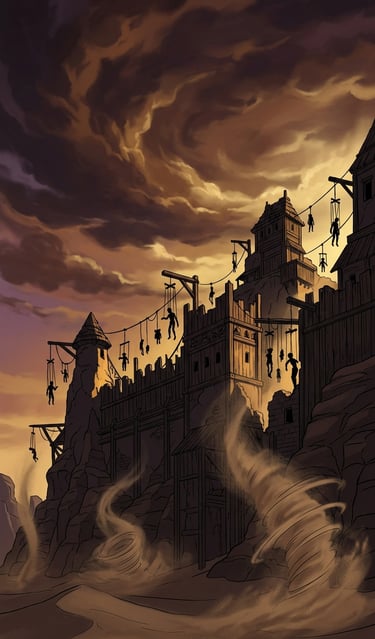
The Fang Clan war party arrived at the Sand & Puppets Village on the morning of the third day of the sandstorm season, which meant visibility was low, which meant they had been watching the approaches for at least a week before deciding to move.
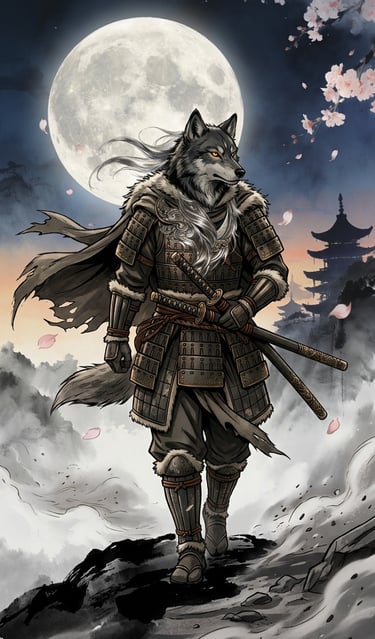
Goro led them. He always led them.
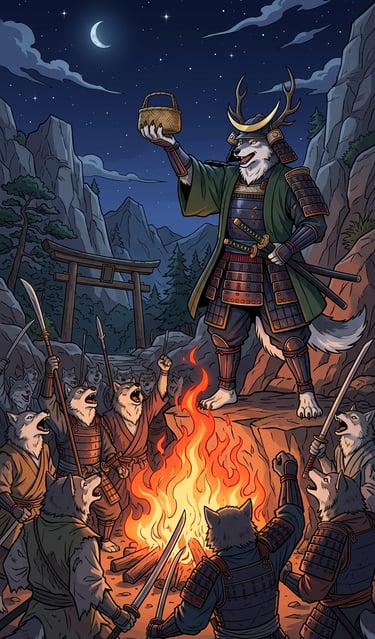
He was not the largest wolf in the pack — that distinction belonged to a warrior named Kuze, who walked three steps behind him and had not spoken in six months following a battle that had removed his ability to form words without pain. Goro was not the fastest, either. He was simply the one who planned. The Fang Clan had swept the northern territories by instinct and hunger — a pack rewrites history when it stops asking permission — but Goro had given them something the other packs didn't carry: he knew where he was going before he left.
He had studied her.
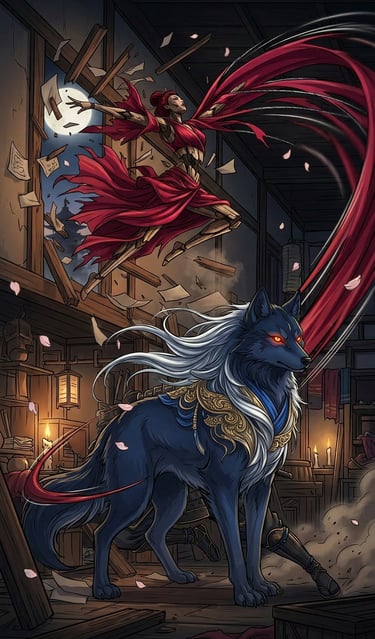
He had spent four months collecting accounts of the Sand & Puppets Village: its defenses, its population, its supply routes, the peculiar nature of its three known combat constructs. He knew about the Hell-Carved Construct — joints that creaked like screaming, ember-chains that could pin three warriors simultaneously. He knew about the Red Lady Crimson-Cloth — a razor-wire dancer who killed at angles that shouldn't exist. He knew about the Eclipse-Born Marionette — the one that was hardest to fight, because it moved to counter attacks that hadn't been thrown yet.
He had prepared for all three.
He had brought twelve warriors, not three. He had told nine of them to wait in the dunes a kilometer back, weapons down, as insurance. Only three stood with him at the workshop door — a show of confidence, a display of contempt that said: I only needed to bring this many.
He knocked.
She said: "It was unlocked seven months ago. You are only now arriving."
He stepped inside.
The Negotiation (Which Was Already Over)
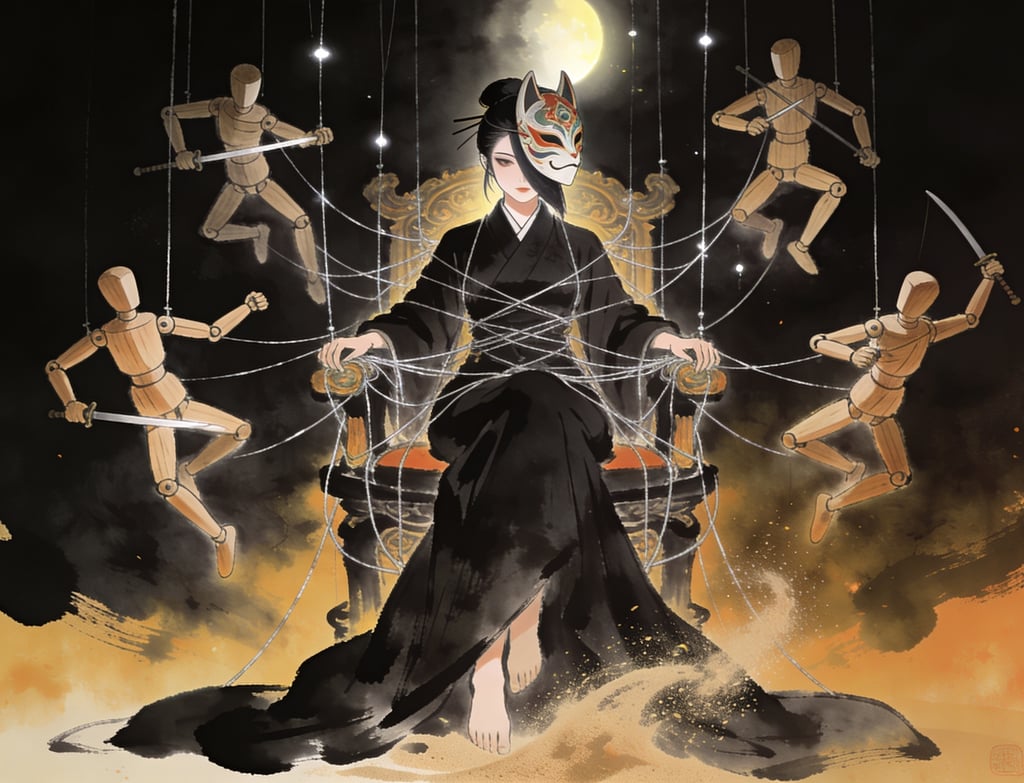
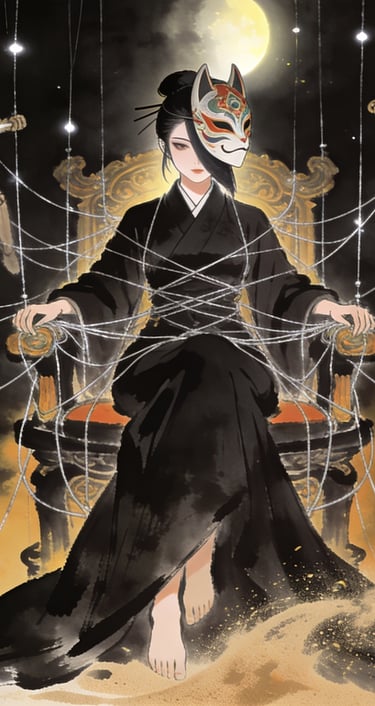
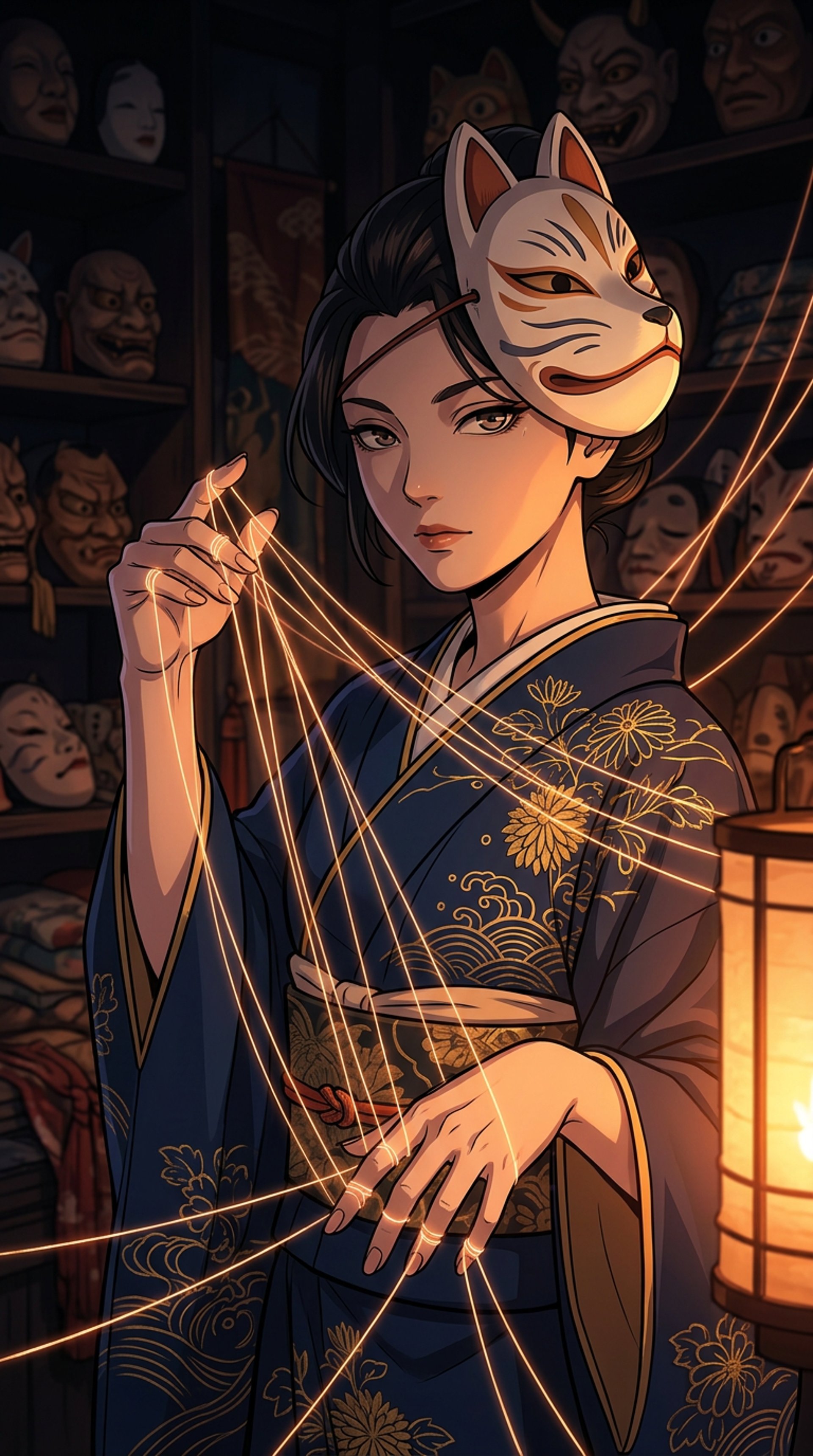
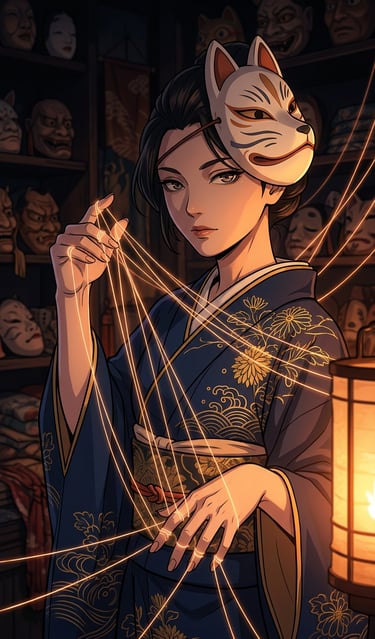
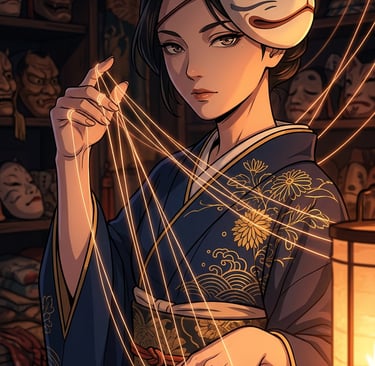
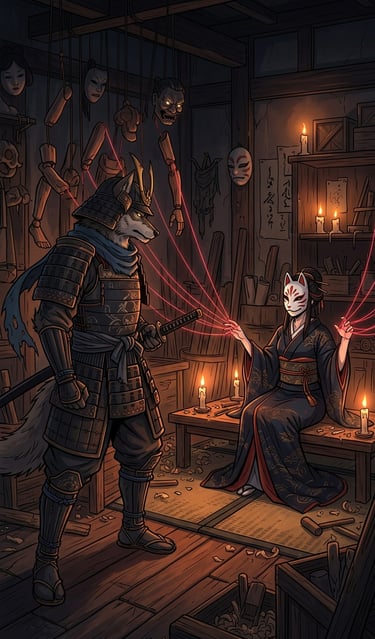
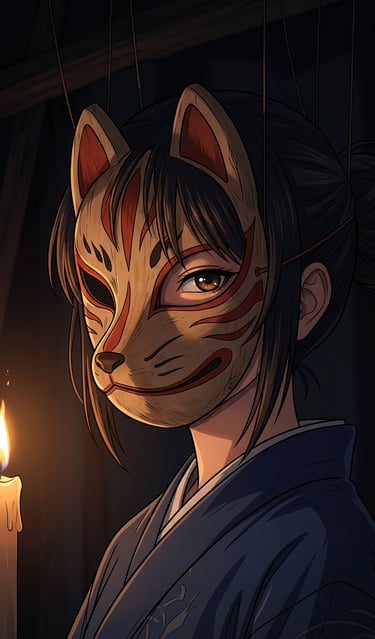
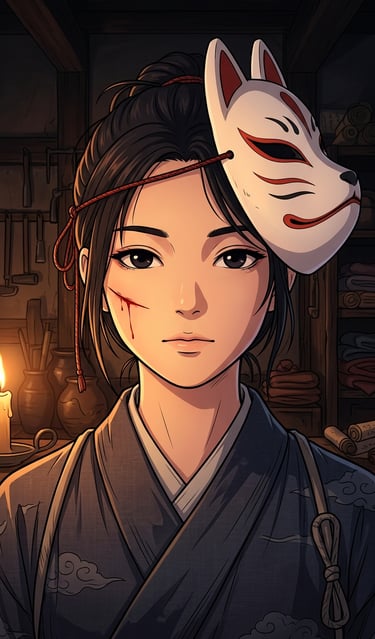
She was seated at the center of the workshop. Fox mask pushed back on her head. Seventeen strings between her fingers, taut and silent in the amber light, the way power is silent when it has nothing to prove.
Her three puppets stood arrayed behind her like furniture — the Hell-Carved Construct crouching near the east wall, ember-chains banked low; the Red Lady at perfect stillness in the corner, silk pooling at her feet like stopped water; the Eclipse-Born Marionette directly behind the throne, its carved face turned slightly downward in what might, on something living, have been called patience.
Goro catalogued all of it in the time it took him to cross the room.
He was thorough. She appreciated that. It takes real intelligence to be completely wrong in detail.
You think you're deciding, she thought, watching his eyes move. I think you're adorable.
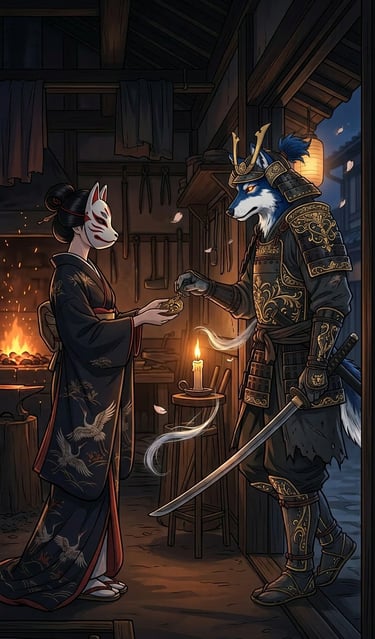
He laid out his terms without sitting down. The Fang Clan was expanding south. The sand territories were geographically inconvenient — not important enough to hold, too defensible to casually absorb, and occupied by a clan whose combat style made a direct assault unnecessarily expensive. So: an arrangement. The Sand Puppet Masters would commit their three primary constructs to three campaigns of the Fang Clan's choosing over the next two seasons. In exchange, the pack would route around the village and leave its trade lines intact. The village would suffer no losses. The constructs would be returned between campaigns.
A generous offer, for a wolf.
"And if I decline?" she said.
"I have twelve warriors in the dunes," he said. "And patience is not a virtue the pack cultivates."
She looked at him for a moment.
"Seven months ago," she said, "a merchant passed through your mountain territory. Old man. Smelled of cedar and bad debt. He told your scouts that this village had weakened. That our puppet-master Yorinobu had suffered an injury that compromised his threading hand. That our sand jutsu stores were down to their last reserves. That we were, in his words, 'ripe.'"
Goro said nothing.
"Did you verify that?"
"We sent our own eyes."
"You sent wolves into a sand village run by a puppet master," she said, "and trusted what they reported."
A silence.
She let it sit there between them, the way sand sits on the floor of a room long after the wind has stopped.
"The merchant," she said, "was mine."
She did not watch his face change. She was already looking at the strings.
What Breaks a Wolf
He did not leave.
That was the interesting thing about Goro, the thing she had not been entirely certain about until this moment: he had enough intelligence to know he had been moved into position, and enough pride to stay anyway. Because leaving now would be an admission. And an admission, in front of three of his own pack, would cost him something that mattered more to him than this village.
So he stayed. And his hand moved to the short blade at his hip.
"It doesn't change what I have in the dunes," he said.
"No," she agreed. "It doesn't."
"You brought me here thinking that was your advantage. Knowing I'd feel manipulated. Knowing I'd be angry."
"Yes."
"So you want me angry."
"I want you present," she said. "You've been present for three minutes and forty seconds. It is sufficient."
He didn't understand that. He was not supposed to.
"Attack," he said.
The three wolves moved.
The Battle (What She Let Him See)
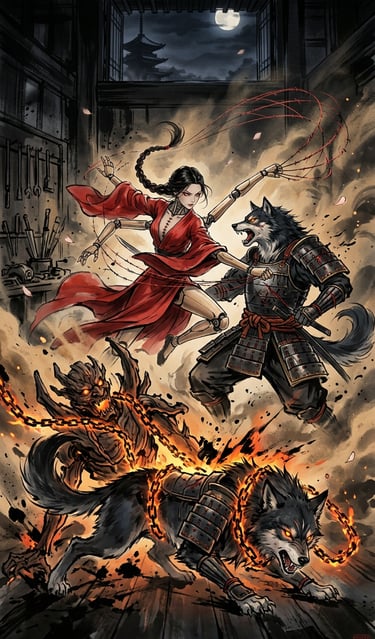
The Red Lady moved first — not because she was commanded, but because she was built to respond to acceleration in the room, and the wolves were fast. She came off the wall like cloth falling from a height, razor-wire silk snapping taut in an arc that should have taken the lead wolf's arm off at the elbow. He dropped, rolled, came up bleeding but whole — he had trained for her, she noted with professional appreciation. He had actually trained.
The second wolf went for the throne.
That was Goro's instruction, she understood — go for the puppeteer, cut the strings, drop the constructs. It was the correct tactical decision. It was exactly what she would have told someone to do.
The Eclipse-Born Marionette stepped into his path before he had committed the strike.
Not after. Before.
The wolf's blade passed through empty air where the Marionette had already stopped being. He adjusted — instinct-fast, pack-trained, genuinely impressive — and the Marionette adjusted with him, its carved face expressionless, its movements a half-second ahead of every decision his body tried to make. He was not fighting a puppet. He was fighting a mirror that had memorized him.
The third wolf reached her.
She did not move from the throne.
His blade caught her across the cheek — the mask's edge redirected it slightly, so it was a graze rather than what it was meant to be, but it drew blood. Real blood. Her blood.
She looked at him.
He looked at her.
She picked up a seventeenth string that had been lying loose across her knee, and she pulled it.
In the east corner, the Hell-Carved Construct came fully awake.
The sound it made was not a battle cry. It was the sound of joints that had been resting for too long suddenly loaded with weight — a chorus of something that had been screaming for years and had learned to do it quietly, and was now no longer interested in quiet.
The ember-chains were not weapons in the way that a blade is a weapon. They were environments. They made the space around them uninhabitable, and they expanded, and the third wolf had three seconds to decide whether to finish what he'd started or remove himself from what was coming.
He removed himself.
She watched him go without changing expression.
The blood on her cheek was warm. She noted this the way you note weather.
Freedom feels real when the strings are transparent. That is the string.
The Thirty-Six Hours
Eight months before Goro arrived at the Sand & Puppets Village, in a high mountain pass between the Fang Clan's eastern territory and the rock-frozen north, there was a sealed location that the wolves had been guarding without knowing they were guarding it.
Not consciously. Not deliberately.
They simply lived there, in the way that wolves live anywhere — claiming the territory, running the perimeter, being present in the way that presence is itself a kind of lock. The Fang Clan's nature was its own security system. No one walked through a territory held by twelve wolves without the wolves knowing.
Which meant that nothing sealed in that territory could be reached while the wolves were there.
She had needed thirty-six hours of an empty pass.
She had spent eight months engineering thirty-six hours of an empty pass.
The merchant was the first thread. The false intelligence about Yorinobu's injury was the second. The reports of weakened sand jutsu stores — seeded through three different sources, two of which Goro's intelligence network trusted implicitly — were the third, fourth, and fifth. The suggestion, appearing in pack council discussion three months ago as if born from Goro's own thinking, that the southern sand territories were a strategic opportunity and a demonstration of pack expansion capability, was the sixth.
She had never spoken to Goro before today.
She had been in conversation with him for eight months.
By the time he arrived at her door, his presence here was not a decision he had made. It was a conclusion he had reached. The difference, from the inside, feels like independence. The difference, from the outside, looks like a string being held very, very lightly.
While Goro's twelve wolves held the sand territories, the mountain pass was empty for the first time in four years.
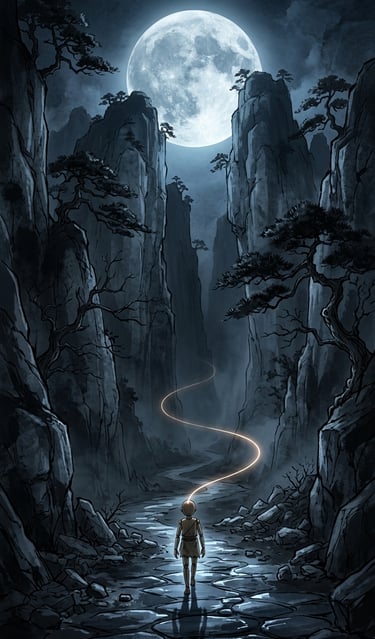
After
Three days later, Goro returned to the mountain territory with tribute and a territorial agreement that gave the Fang Clan an auxiliary route through the sand territories' eastern edge — a small thing, practically meaningless, that he had negotiated out of the otherwise total failure of his original objective.
The pack received him as a war chief who had extracted something from nothing. They called it efficient. They called it shrewd.
In the council fire that night, Goro told the story of the Sand Puppet Masters' puppet battle — the Red Lady, the Marionette, the Hell-Carved Construct — and three of the younger wolves asked him if they could train to fight constructs, and he said yes, and for two hours the pack was animated and hungry and proud, and no one asked what had been in the mountain pass, because as far as they knew, nothing had happened in the mountain pass.
The pack was whole. The pack was confident. The pack had, they believed, demonstrated their power and extracted a concession from a woman who manipulated for a living.
They thanked him for it.
True manipulation is when they thank you for the cage.
In the workshop, in the Sand & Puppets Village, she pressed a clean cloth to the cut on her cheek.
She thought about Goro's face as he'd left. The way he'd carried the tribute in his hands.
The way his shoulders had settled into something that was not peace, exactly, but was close enough to rest.
The particular posture of a person who has decided that what happened was acceptable. Was even good. Was a result they had earned through their own capability.
Seventeen strings.
One per lesson she has learned that cannot be unlearned.
The eighteenth she keeps loose.
For the student who finally asks the right question.